 blog
blog
Does Outdoor Learning Improve Test Scores? Yes, Here's How
Why Traditional Classrooms Struggle to Produce Lasting Learning
Table of Contents
- Outdoor Learning Academic Performance: What the Evidence Shows
- Outdoor Education Research: Global Studies That Changed the Conversation
- How Outdoor Learning Improves Test Scores: The Mechanisms at Work
- Outdoor Learning Activities for Elementary Students That Build Academic Skills
- How Much Outdoor Learning Is Enough for Real Academic Gains?
- What Outdoor Learning Looks Like in Practice: A Kane County Example
- Sources
- Frequently Asked Questions
Last Updated: October 5, 2026
Outdoor Learning Academic Performance: What the Evidence Shows
Does outdoor learning improve test scores? The best current answer is a qualified yes. Across studies from Denmark, the UK, and the United States, students who learn regularly outdoors tend to do as well as or better than peers taught only indoors. Some studies find measurable gains in reading, engagement, and focus. The effects are usually modest, and many studies are small. But the direction is consistent, and the evidence that outdoor learning harms academic progress is thin.
This guide from Headwaters Community Farm & Academy, a small nature-based school in Aurora, Illinois, looks at what the research actually shows, why it matters, and how families and teachers can put outdoor learning to work.
First, a definition. Outdoor learning is structured teaching that happens in natural settings, with real academic goals. It isn't recess, and it isn't a field trip. It's a way of teaching.
Why Traditional Classrooms Struggle to Produce Lasting Learning
Most American classrooms still run on a structure built more than a century ago: rows of desks, bell schedules, and units that end in a test. Plenty of excellent teaching happens inside that structure. But the structure itself makes one thing hard. Students often learn material well enough for the test, then lose much of it by the next unit.
Retention tends to depend on context. Ideas tied to direct experience have more to hold on to. A child who measures the same seedling every week for six weeks has watched a rate of change happen. When she meets the idea again on paper, she already knows what it's describing.
The Shift Toward Adaptive, Real-World Education
Around the world, education systems are moving toward adaptive models that treat the outdoors as a classroom rather than an escape from one. These approaches share three traits: they respond to the individual learner, they build resilience through manageable challenge, and they connect content to consequences in the real world.
UNESCO's report on education for sustainable development documents how schools across Europe have embedded environmental and experiential learning into national curricula, not as an add-on but as a delivery method.
The question is no longer whether nature-based education works. It is how to do it well.
Outdoor Education Research: Global Studies That Changed the Conversation
Research on outdoor learning has grown more careful over the past two decades, though it still has limits.
A 2017 systematic review in the International Journal of Environmental Research and Public Health looked at 13 studies of regular, curriculum-based outdoor teaching. Eleven found positive effects on students' social, academic, physical, or psychological development. The authors also noted that the studies' methods were often weak, and they called for larger, longer studies.
A 2019 review in Frontiers in Psychology went further. Its authors acknowledged that many individual studies use weak designs, but argued that together they make a convincing case that experiences with nature promote learning. They pointed to evidence on retention, test scores, grades, and engagement.
European Models Leading the Way
In Denmark, outdoor teaching has a name: udeskole, or outdoor school. Classes spend regular, scheduled time learning outside, often a few hours each week.
The Danish TEACHOUT study followed 30 classes in grades 3 to 6 for a school year. Students who received more than two hours a week of outdoor teaching made small but measurable gains in reading compared with peers in conventional classes.
Scotland's Curriculum for Excellence says every child's education “must include opportunities for a series of planned, quality outdoor learning experiences.” Teachers are encouraged to teach math, literacy, and science in schoolyards, parks, and woodlands.
What these systems share is patience. They started, paid attention, and adjusted.
One practical lesson from this work: don't use the outdoors only as a reward for finishing indoor work. Try it the other way around. Introduce a concept outside, through direct experience, then come inside to practice and extend it.
How Outdoor Learning Improves Test Scores: The Mechanisms at Work
Researchers have proposed several reasons outdoor learning may support academic work. Four come up most often.
Attention. Focus runs down over a school day. One leading theory, attention restoration, holds that natural settings let it recover. In a 2018 study of matched lessons, third-graders were noticeably more engaged in the classroom after a lesson outdoors than after the same lesson taught inside. Teachers had to redirect them about half as often.
Learning through the body. Counting stones, pacing out distances, and tracking the seasons give students more than one way into an idea. When a concept is tied to something they did, they have more to recall it by.
Calm. Children learn more easily when they aren't overwhelmed. Outdoor settings often lower the temperature of a hard day, and they give students real chances to practice calming down, negotiating, and recovering from frustration. At Headwaters, we teach those skills directly, then let the outdoors supply the real situations to practice them.
Motivation. Students work harder at things when they can see why they matter.
Mechanism | What It Does | Academic Effect |
|---|---|---|
Attention restoration | Lets directed focus recover | Longer concentration, fewer redirects |
Learning through the body | Gives an idea more than one way in | Stronger recall of concepts and procedures |
Calm | Lowers stress, builds self-management | More of the lesson actually absorbed |
Motivation | Connects work to real outcomes | More effort, more persistence on hard tasks |
Outdoor Learning Activities for Elementary Students That Build Academic Skills
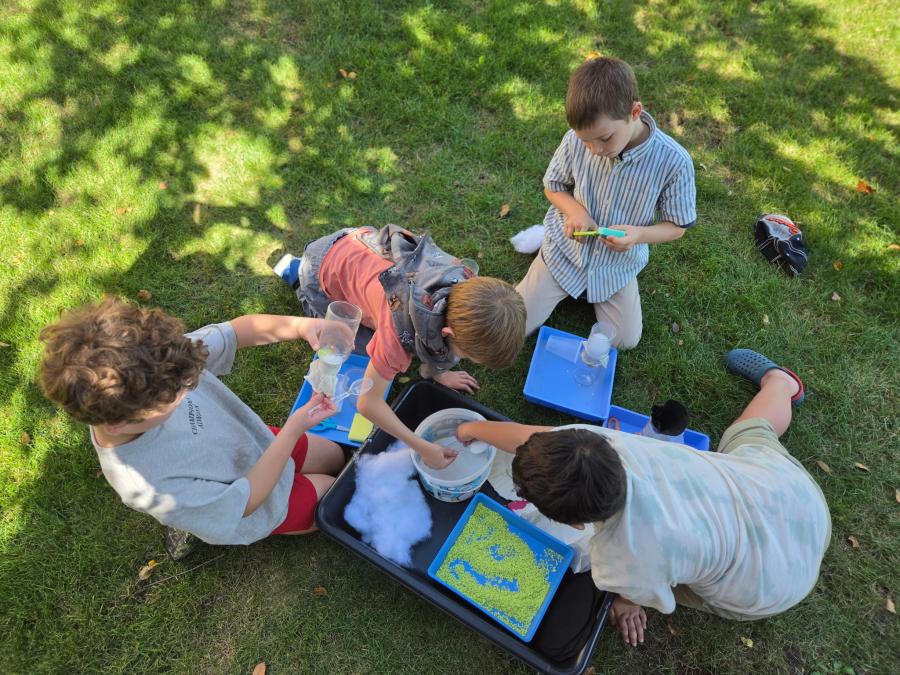
Outdoor learning activities for elementary students work best with a specific academic target. The goal isn't simply to be outside. It's to learn something that is easier to learn there.
Related: Outdoor Project-Based Learning: What It Is, What the Research Says, and Why Place Matters
Try these:
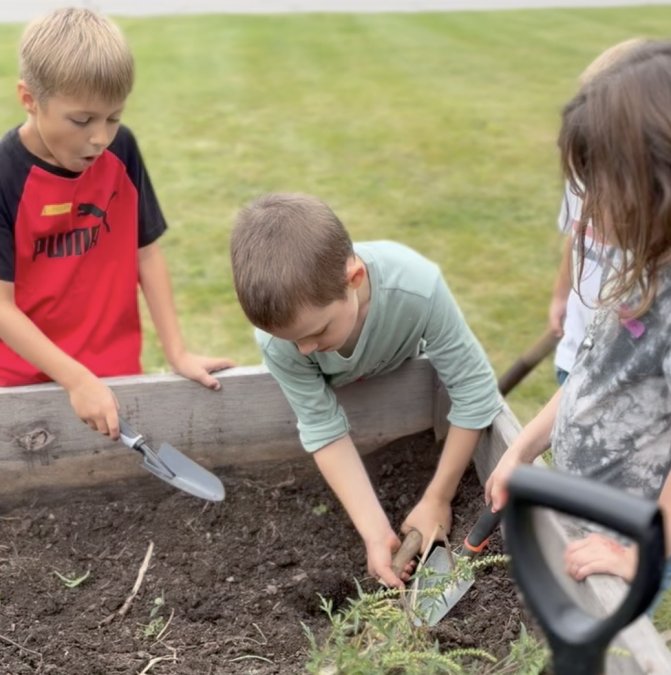
- Garden measurement journals. Students measure plants weekly, record the data, and graph the change. That's measurement, data literacy, and writing in one ongoing project.
- Weather logs. Daily temperature, cloud cover, and rainfall, recorded by hand, build the pattern recognition science depends on.
- Mapping the schoolyard. Scale drawing, estimation, and geometry, applied to a place students already know.
- Reading outdoors. Fluency practice in the shade is still fluency practice, and many children keep at it longer.
- Citizen science counts. Tracking birds, insects, or pollinators teaches data collection, classification, and careful observation.
The setting doesn't water down the content. It gives it something to hold on to. And the same activities grow with students: the fourth-grader's plant journal can become a high school student's designed experiment.
How Much Outdoor Learning Is Enough for Real Academic Gains?
There isn't a proven formula yet. The clearest data point comes from the TEACHOUT study, where reading gains showed up for classes that spent more than two hours a week learning outside. Across the research, regular and consistent time seems to matter more than occasional big outings.
Here is a rhythm we find works:
- Daily: some outdoor time with a learning purpose, not only free play.
- Weekly: a longer outdoor block with a clear academic focus.
- Seasonal: projects that run across weeks, like a growing cycle or a creek study.
A school that manages only the weekly block is still doing meaningful work. A school that manages all three starts to build a culture.
What Outdoor Learning Looks Like in Practice: A Kane County Example
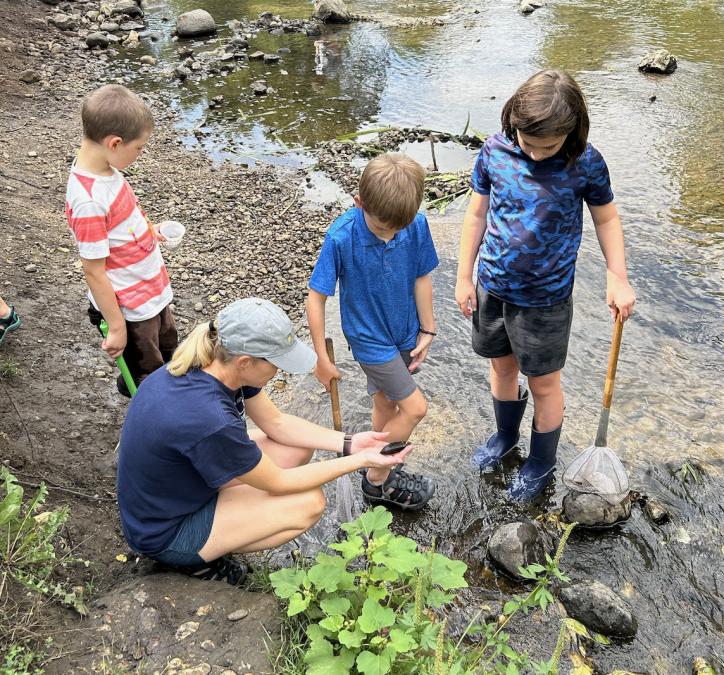
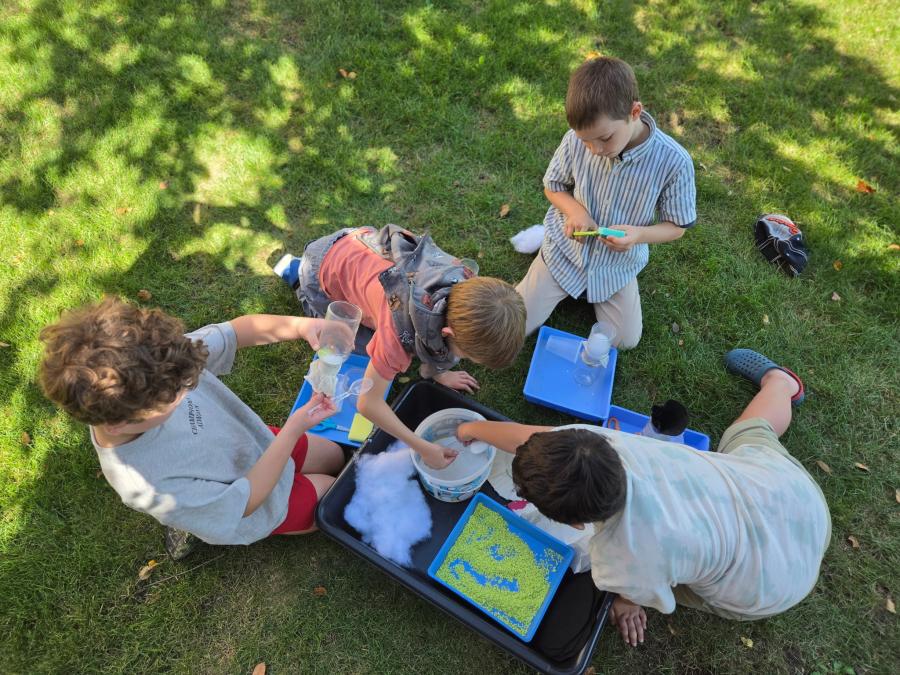
In practice, outdoor learning looks less dramatic than people expect. Often it's a few students crouched at the edge of a creek with nets and sorting trays, arguing about what exactly they just caught.
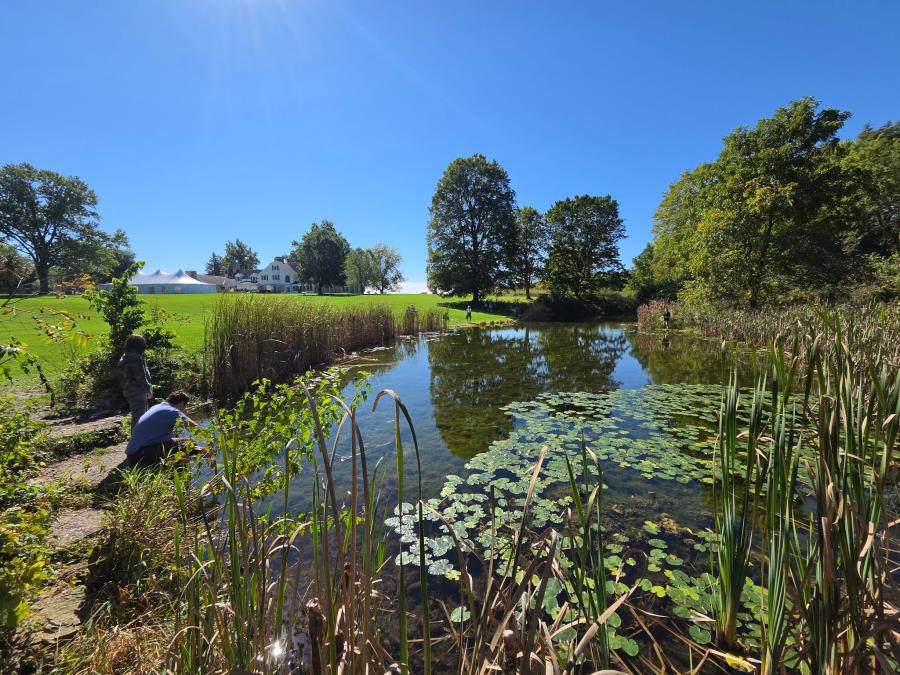
At Headwaters, our school is based in Aurora, and students spend substantial time outdoors: in gardens, at local creeks and parks, and on regular trips out into the Fox Valley. Food production runs through the curriculum. Students plant from seed, tend, harvest, and preserve, with the measuring, science, and planning that stack up along the way. They return to the same places again and again, and each visit asks a little more of them.
Families often ask whether their child will fall behind after leaving a more traditional classroom. In our experience, the first few weeks are an adjustment. After that, most children settle into deeper work than before. Our teachers hold master's degrees in education and bring years of classroom experience.
For homeschooling families, our seasonal homeschool programs and family learning resources bring the same approach within reach, whether you're in Aurora or much farther away.
If you're searching for nature-based education near you, the real question is fit. Does the program match your child? And can you see the academics clearly enough to trust them? Ask what students are learning, and why.
Getting children to learn outside is rarely the hard part. They take to it faster than adults do. The hard part is finding a program rigorous enough to meet your standards and human enough to keep your child curious.
Headwaters is a nonprofit community garden and Montessori-inspired academy in Kane County, built around a small, intentionally human microschool where students learn through land-based projects, explicit social-emotional teaching, and structured academics. Our teachers and staff bring deep classroom experience and advanced degrees.
Learn more about how we build curious, resilient learners at Headwaters.
Sources
- Becker et al. (2017), “Effects of Regular Classes in Outdoor Education Settings: A Systematic Review,” IJERPH: 13 studies, 11 positive; the authors rate the methods as weak on average.
- Kuo, Barnes & Jordan (2019), “Do Experiences With Nature Promote Learning?” Frontiers in Psychology: argues converging evidence supports a cause-and-effect link, while noting individual studies are often weak.
- Otte et al. (2019), “Education Outside the Classroom Increases Children's Reading Performance,” International Journal of Educational Research: Danish TEACHOUT study, 30 classes in grades 3–6, small reading gains with 2+ hours a week outdoors.
- Kuo, Browning & Penner (2018), “Do Lessons in Nature Boost Subsequent Classroom Engagement?” Frontiers in Psychology: matched indoor and outdoor lessons for third-graders; teacher redirects fell by about half after outdoor lessons.
- Education Scotland (2010), Curriculum for Excellence through Outdoor Learning: source of the “must include opportunities” quotation.
Frequently Asked Questions
Does outdoor learning actually improve test scores?
Yes. A growing body of outdoor education research shows that students who learn outdoors regularly outperform peers in traditional settings on standardized measures of reading, math, and science. The gains come from several factors: increased attention, reduced stress, hands-on application of concepts, and stronger retention when learning connects to real environments. Schools that integrate outdoor learning into their weekly schedule see measurable academic benefits without sacrificing curriculum coverage.
How much outdoor learning is enough to see academic benefits?
Research suggests that even short, regular outdoor sessions produce measurable gains. Some studies show benefits from as little as one outdoor lesson per week, while others point to daily outdoor time as ideal for attention and retention. The key is consistency rather than duration. Programs that blend structured academics with frequent outdoor exploration, like those at nature-based schools, tend to see the strongest results across grade levels.
Can outdoor lessons still meet state academic standards?
Absolutely. Outdoor learning does not replace academic content; it delivers it differently. Teachers can cover math through measuring and mapping, science through direct observation, and literacy through nature journaling. Many nature-based and Montessori-inspired programs align their outdoor curriculum with state standards while using the environment as the primary classroom. The result is the same academic rigor with stronger engagement and retention.
Does outdoor learning help students with attention and resilience?
Yes. Time outdoors is linked to improved focus, reduced stress, and better emotional regulation in children. When students learn in natural settings, they practice problem-solving in unpredictable conditions, which builds resilience and adaptability. These skills carry back into the classroom and into test-taking situations, where calm focus and persistence matter as much as content knowledge.