 blog
blog
Secular Private Schools in Fox Valley: A Parent's Guide
Last Updated: September 2026
Choosing a Secular Private School in the Fox Valley: A Guide for Families
Thinking about a secular private school in Kane County or elsewhere in the Fox Valley? Here's how to compare Montessori, Waldorf, and nature-based options, what admissions usually looks like, and what the first months of a new school can feel like for your family.
Most families who come to visit Headwaters aren't unhappy with school in general. They've noticed something specific about their own child. Maybe she's curious but running out of room to ask questions. Maybe he's capable but restless, or quietly shutting down. Or the family simply wants their child's days to feel different: slower, deeper, more connected to real things.
If that sounds familiar, you're not alone. More and more Fox Valley families are looking at secular private schools. That usually means smaller communities, teachers who know each child well, and a clear educational philosophy at the center. "Secular" means the school's mission is built around human development and community rather than a religious tradition, so families of every belief, or none, can feel at home.
This guide is our attempt to help you think it through honestly, including the parts that are harder than the brochures suggest.
Start with your family, not the schools
Before you compare programs, it helps to get clear on what matters most to you. Is it time outdoors and a connection to the land? Room for your child to move at their own pace? Strong relationships with teachers? Real projects instead of worksheets? A community where you know the other families?
There's no right answer. But the families who find the best fit usually know their priorities before they tour, because it's easy to fall for a beautiful campus that doesn't match what your child actually needs.
It also helps to watch your child closely for a few weeks. When are they most absorbed? What drains them? Those observations will tell you more than any school's website.
Montessori and Waldorf: two different paths
Montessori and Waldorf are two of the most established alternatives to conventional schooling, and they're often grouped together. In practice, they feel quite different.
Montessori is built around self-directed work in a carefully prepared environment. Children choose from hands-on materials, work at their own pace, and build concentration and independence over long, uninterrupted stretches. The adult's role is to observe closely and guide when it's needed, not to lead from the front. Montessori classrooms usually mix ages, so younger children learn from older ones, and older children learn by teaching.
Waldorf weaves academics together with art, movement, music, and storytelling. Subjects are introduced according to a developmental sequence, and in many Waldorf schools a class stays with the same teacher for several years. The emphasis is on the whole child, including imagination and rhythm.
Here's a simple way to picture the difference. In a Montessori room, a seven-year-old might spend forty-five minutes working alone with number rods until a math concept clicks. In a Waldorf room, the same idea might arrive through a story about a merchant counting goods, followed by movement and a drawing.
Neither is better in the abstract. Many children thrive with Montessori's independence and concrete materials. Others come alive with Waldorf's narrative and artistry. A good fit depends on your child's temperament, not on which philosophy sounds best on paper.
A note for families specifically looking for secular schools: Waldorf education grew out of Rudolf Steiner's spiritual philosophy, anthroposophy. Most Waldorf schools don't teach religion, but the influence shows up in different ways from school to school. Additionally, some Montessori schools are loosely aligned with a religion, like Carmel Montessori in Warrenville, or supported by a spiritual community, like Green Friends Montessori in Elburn. If this matters to you, ask about it directly.
Some schools, including ours, draw on one tradition while adding others. Headwaters is Montessori-inspired and rooted in real time outside, so children's independent work extends outdoors and into real responsibility for the land.
Nature-based and land-connected learning
In the Fox Valley, farmland, prairie, and river corridors are still close at hand, and a growing number of families are looking for schools that make use of them.
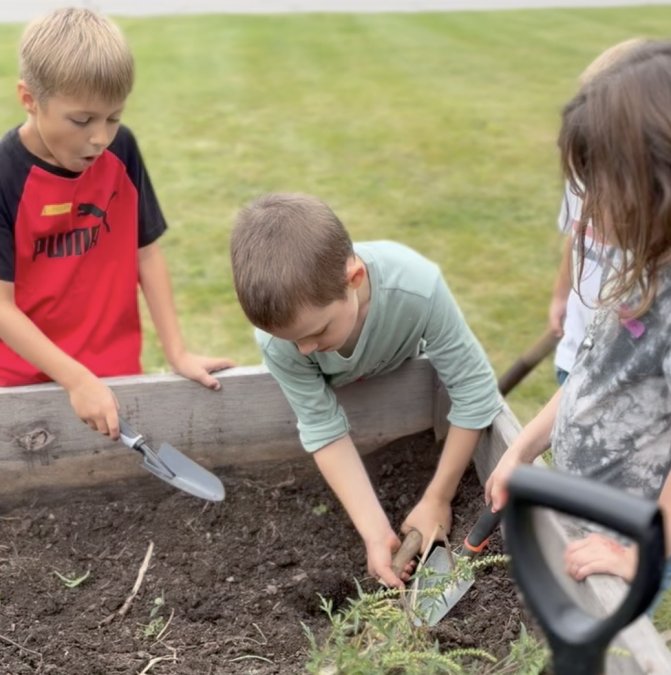
In a truly nature-based program, time outside isn't a break from learning. It's where much of the learning happens. Children study ecology and food systems by planting, tending, and harvesting. Math shows up when they measure beds or calculate a harvest. Writing grows out of field observations and letters about projects they care about. Children also build resilience by working in real weather, and they learn empathy by caring for living things that depend on them.
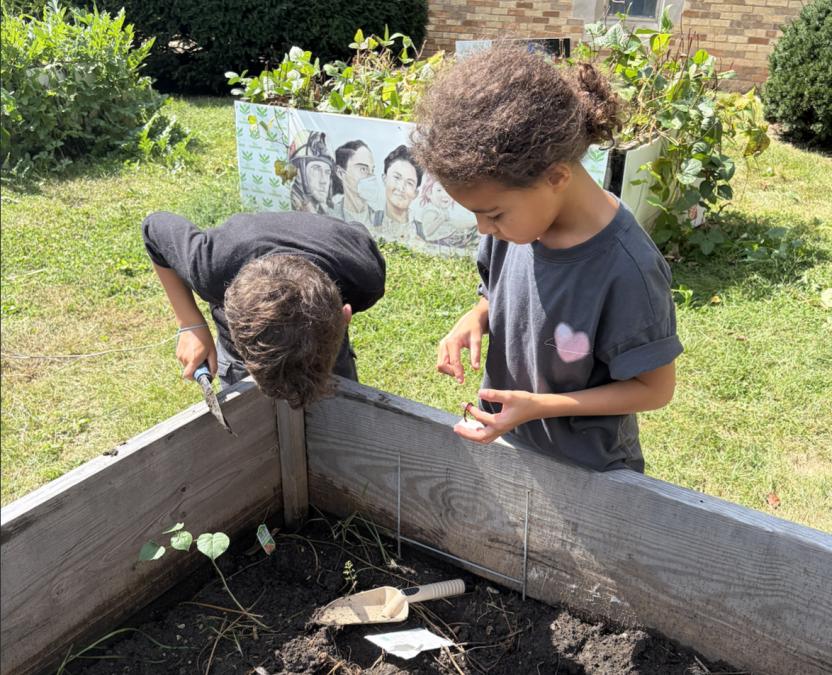
At Headwaters, the garden is part of the academic day. Students take part in growing food, restoring habitat, and caring for the land, and those experiences are the curriculum rather than an add-on.
If outdoor learning matters to your family, ask every school the same questions. How many hours a day are children outside, in every season? What do students actually grow, build, or care for? Is the nature work real, or mostly observation? What happens on the coldest days of January?
Private school admissions in Illinois
Admissions processes vary from school to school, but you'll usually see some combination of an application, a visit or observation day for your child, and a conversation with parents. Some schools use standardized assessments. Others, especially Montessori and nature-based schools, prefer to watch how your child engages with the environment.
Illinois leaves admissions decisions largely to each private school, so ask every school how it makes those decisions and what its enrollment policies are.
If your child has an IEP, a 504 plan, or other learning needs, bring it up early and openly. Some small schools have deep experience with learning differences, and others have limited capacity, and most have limited staff. An honest conversation up front protects your child from a mismatch later.
Timing matters too. Many small schools accept applications on a rolling basis, but spots can fill by spring. If you're thinking about the fall, winter is a good time to start visiting. We start touring in October and open enrollment in November.
What daily life and community look like
One of the biggest differences families notice is size. Smaller schools and smaller groups mean adults can know each child well, including how they learn, what frustrates them, and what lights them up. For example, our teacher student ratio is rarely more than 1:7, and usually much smaller.
The curriculum follows the school's philosophy. Montessori schools follow a Montessori scope and sequence. Waldorf schools follow a developmental curriculum. Nature-based and project-based schools often organize learning around seasons, ecosystems, or real community questions. The best schools can explain not only what your child will learn, but how and why they believe their approach works.
Community tends to feel closer, too. Families often know one another, and many small schools invite parents into real involvement through volunteering, shared projects, or even governance. For some families, that's one of the best parts. For others, it takes some adjustment.
It's also worth asking honestly about who is in the community. Small schools can end up less diverse than they mean to be, economically, culturally, and in other ways, unless they work at it. Ask what a school is actually doing to be accessible and welcoming, including how it approaches tuition assistance.
What the transition can feel like
If your child is coming from a more traditional classroom, give the change some time and patience.
Children used to being told what to do next may feel unsure at first when the choice is theirs. You might hear, "I didn't know what to do." That's normal. For most children, the uncertainty gradually turns into initiative, though the timeline is different for every child.
Some things parents commonly notice in the first months: children coming home more physically tired, especially from long days outside; less homework than they're used to; and reports that "we didn't do math today," when in fact they spent the morning measuring garden beds.
A few things help. Stay in regular contact with your child's teacher, and share what you're seeing at home. Try to ease off pressure around homework and grades while your child settles in. And be ready for your own adjustment, too. If your child has been rewarded mostly for compliance and good grades, a school that measures growth through engagement, persistence, and curiosity can feel unfamiliar at first. Many parents describe it as a relief, and some find it takes a while to trust.
Questions to ask before you enroll
Marketing materials only tell you so much. These questions tend to show what a school is really like.
About teachers. Are teachers trained in the school's approach? How long do they usually stay? Continuity matters a great deal to children.
About a typical day. Can you visit on an ordinary school day, not only on a scheduled tour? How much of the day is uninterrupted work time? How much is outdoors?
About how learning is tracked. How will you know how your child is doing? Does the school use conferences, portfolios, written narratives, or assessments?
About support. How does the school respond when a child is struggling, academically, socially, or emotionally?
About money. What does tuition include? Are there additional fees? How much has tuition gone up in recent years? Are there payment plans or tuition assistance?
About the long view. What ages does the school serve? Where do students usually go next, and how does the school help families prepare for that move?
The answers matter, and so does the way a school answers. Look for openness, specifics, and a willingness to say what they don't do well.
Frequently Asked Questions
What's the difference between secular and religious private schools in Illinois?
Religious private schools integrate a faith tradition into teaching and school life. Secular private schools center their mission on academics, character, and community without religious instruction, so they're open to families of all beliefs or none. Both are private schools and both are legal options in Illinois.
Are there secular Montessori schools in the Fox Valley?
Yes. Several Montessori and Montessori-inspired programs operate in the Fox Valley, and they vary widely in size, age range, and how much time children spend outdoors. Visit more than one, since two schools using the same name can feel very different. Headwaters is a Montessori-inspired, farm-based school in Kane County.
How can I check a private school's accreditation or status in Illinois?
Ask the school directly which organizations, if any, accredit it, and what that accreditation involves. Common accrediting bodies include the Independent Schools Association of the Central States (ISACS) and Cognia. Many small and alternative schools aren't accredited, and that isn't necessarily a red flag. The more useful question is how the school holds itself accountable. You can also ask whether the school is registered or recognized with the Illinois State Board of Education.
Do secular private schools in Kane County offer financial aid?
Many do, through need-based assistance, sliding-scale tuition, sibling discounts, or payment plans, though options vary a lot from school to school. Ask about aid early in the process rather than after you've fallen in love with a school. [Confirm: what Headwaters offers.]
What ages are best for starting at an alternative school?
Children can make the move successfully at many ages. Younger children often adjust quickly, while older children may need more time and support, especially if they're used to grades as the main measure of success. The right time is usually when you've found a school that truly fits your child.