 blog
blog
Outdoor Project-Based Learning: What It Is, What the Research Says, and Why Place Matters
What is outdoor project-based learning, and does it actually work? An honest look at the research, what makes a project real, and what this kind of learning looks like at a small nature-based school in Aurora, Illinois.
Table of Contents
- What is outdoor project-based learning?
- Nature as a place, not a field trip
- What makes a project real
- What the research actually says about project-based learning
- Why the body matters for learning
- Stacked learning: why coming back matters
- What tests can and can't tell us
- What outdoor project-based learning looks like at Headwaters
- Frequently Asked Questions
Last Updated: September 2026
The first time we take children somewhere new, they mostly notice the rules. Where are we allowed to go? Where's the bathroom? When do we leave?
By the fifth or sixth visit, they notice different things. They know where water collects after a storm. They've picked a favorite tree. They see that the plants along the path have changed since last month, and they want to know why.
That shift, from visitor to someone who knows a place, is where much of the learning we care about begins. It's also a big part of why we build so much of the school day around outdoor, project-based work.
What is outdoor project-based learning?
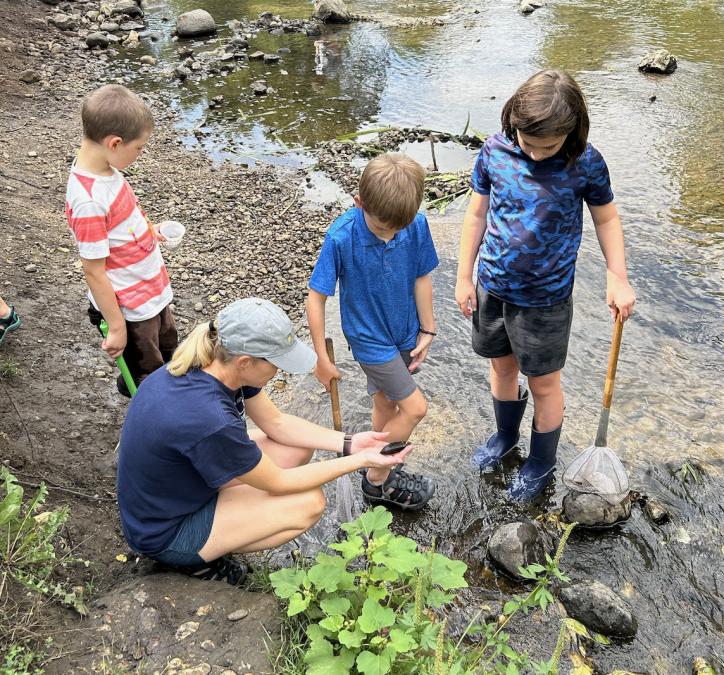
Outdoor project-based learning is a way of teaching where children build academic skills through real, extended projects in outdoor settings. They might tend a garden, study how water moves across a site, track seasonal change, or build something that has to actually work. The reading, writing, math, and science happen inside that work, not beside it.
At Headwaters, a small, secular, Montessori-informed school in Aurora, this shapes much of the day. Children spend substantial time outdoors, work in the garden, and return regularly to the same offsite places throughout the year. Our teachers bring years of classroom experience to this work, including more than 25 years in Illinois middle schools and Montessori certification for the lower and upper elementary grades.
Nature as a place, not a field trip
A lot of outdoor education happens in single visits: a trip to a nature center, a day at a park. Those can be wonderful. But they rarely give children time to really know a place.
We've noticed that the richest learning tends to show up after the novelty wears off. On a first visit, children are taking in everything at once. By the tenth, they're paying attention to details. They notice that the creek is higher than last week. They remember that a certain patch of ground stays muddy after rain. They start asking questions that only someone who has been paying attention would think to ask.
We think of it as a chain: familiarity leads to belonging, belonging leads to ownership, and ownership can grow into stewardship. Children care for places they know. And a place they know and care about gives them real problems worth thinking through.
What makes a project real
"Project-based learning" gets used loosely. Sometimes it means a poster at the end of a unit. We mean something more specific, and we use four questions to check whether a project is truly doing its job.
Does it have real consequences? If the garden bed isn't watered, the seedlings die. If a structure isn't measured correctly, it won't stand. Children can tell a pretend problem from a real one, and they bring a different kind of effort to real ones.
Does it have a real audience? Work that someone will actually use, read, or eat asks more of a child than work only a teacher will see.
Does it take time? Real projects last weeks or even a whole season, long enough for children to get confused, make mistakes, revise, and finish.
Does it require the academics? A good project can't be completed without reading, measuring, calculating, writing, or explaining. The skills aren't decoration. The project depends on them.
When all four are true, children tend to become absorbed in their work.Why Regurgitating Facts and Passing Tests Does Not Prove Learning
A passing test score proves a child can retrieve information on a specific day. It does not prove they understand it, can use it, or will remember it in a year.
Regurgitation is short-term recall under pressure. Real learning shows up when a child applies an idea in a new situation, weeks later, without being prompted. That is the difference between memorizing the water cycle and explaining why the farm's low field floods every spring.
Tests measure compliance with a timeline. They do not measure whether learning took root.
What the research actually says about project-based learning
Moving to a Microschool: A Guide for Families in Kane County
The research on well-designed project-based learning is stronger than many people realize. In a large study by Michigan State and University of Michigan researchers, third graders in project-based science classrooms outperformed peers in traditional classrooms by 8 percentage points on a summative science assessment, and they also grew in self-reflection and collaboration. The study was rigorous: schools were randomly assigned, and it included 2,371 third-grade students. The gains weren't limited to strong students, either. Struggling readers in the project-based classrooms outperformed struggling readers taught with more traditional approaches.
There's an important caveat, and we take it seriously. The program in that study included high-quality professional development, which the researchers considered necessary for teachers moving from traditional instruction to rigorous project-based learning. Project-based learning works when it's done well, by teachers who know how to structure it. A loose project with no clear academic purpose isn't the same thing.
The research on learning outdoors is also encouraging, and some of the best-known work comes from here in Illinois. Researchers at the University of Illinois at Urbana-Champaign set out to test a common worry among teachers: that an outdoor lesson would leave children too keyed up to focus afterward. They compared carefully matched pairs of lessons, one in a natural outdoor setting and one indoors, then observed how engaged students were in the indoor lesson that followed. They repeated this across 10 different topics and weeks of the school year in two third-grade classrooms. Students were more engaged after the lessons in nature, not less.
The researchers were careful about why. They suggested several factors likely work together: physical activity, the effect of nature on stress and attention, a change of scenery, and teachers getting a breather of their own. We appreciate that honesty. Outdoor learning isn't magic. It works through ordinary, understandable things, like moving, breathing, and resetting, that most school days don't leave much room for.
To be clear about the limits: much of the research on outdoor learning is still developing, and many studies are small. We don't think the evidence says children should never sit at a desk. We think it says real work and time outdoors deserve more of the school day than they usually get.
Why the body matters for learning
When children dig, carry, climb, balance on uneven ground, and work with their hands, they build coordination and body awareness. Many children also find it easier to settle their attention afterward.
We see this regularly. After a stretch of real physical work outside, most children come back to focused tasks calmer and more ready to think. It isn't complicated. A child who feels steady in their body has more attention available for learning than a child who has spent the morning working hard to sit still.
Stacked learning: why coming back matters
We use the term stacked learning for something we see all the time: skills that build through connected experiences over weeks and months, rather than in separate units that end on Friday.
A child who tends the same garden bed across a season isn't repeating a task. Early on, they're measuring and planning. Later, they're tracking growth and troubleshooting problems. By harvest, they're comparing results to their predictions and writing about what they'd change. The same is true of returning to the same outdoor place month after month. Each visit builds on what they noticed last time.
This connects to some of the most established findings in learning science. People remember more when they return to ideas repeatedly over time, and when new learning connects to what they already know. Returning to the same projects and places builds that in naturally.
What tests can and can't tell us
We're not against tests. There's good evidence that practicing recall, meaning pulling information back out of memory, helps children remember it. Quizzes and tests can be useful tools.
What a test can't easily show is whether a child can use an idea somewhere new. That's the kind of understanding we care most about. Memorizing the water cycle is one thing. Explaining why one corner of the garden floods after every storm, and proposing what to do about it, is another.
So we pay attention to both: what children can recall, and what they can do with it. Some of our clearest evidence of learning comes from watching a child take an idea from one project and use it, without being prompted, in the next.
What outdoor project-based learning looks like at Headwaters
Our current bird study stretches across multiple seasons. Students learn in the classroom, work with specimens and nature artifacts, practice observation and classification, read and write about what they’re noticing, and then carry those questions with them to Leroy Oakes Forest Preserve on Fridays. Going back to the same place matters. A bird is no longer just an illustration in a book; students can begin noticing habitat, behavior, seasonal change, and patterns that only become visible when you return.
Our homeschool students are doing the same kind of work through Harvest & Roots, our enrichment program: the eight-week session follows the garden and the season rather than treating each Thursday as an unrelated activity. Children return to the same outdoor spaces and the same group each week, work with plants and natural materials, make things, observe what is changing, and build toward a shared harvest experience. Even something as simple as our autumn equinox afternoon - apples, acorns, art, food, and the changing season - gives children a reason to notice, compare, create, ask questions, and talk about what they see.
None of these begin as a math lesson or a writing assignment. But the skills show up everywhere: measuring, estimating, sequencing, recording, reading, describing, calculating, revising, explaining, and deciding what to do next. That is part of the point. Children practice academic skills because the work in front of them actually requires those skills.
Families learning at home can experience a version of this too. Our homeschool enrichment programs bring children back to the same place, the same garden, and the same people each week, so they have time to settle in, notice change, build relationships, and start taking real creative risks.
For most families, the hardest part isn't finding time for outdoor learning. It's trusting that a child absorbed in real work outside is learning more, not less, than a child filling out a worksheet.
That trust is what we're building Headwaters around. We're a young school, and we're honest about that. But as a team we've watched enough children come to know a place, and start caring about it, to be confident in what it makes possible. If you'd like to see it for yourself, come visit on an ordinary morning. Schedule here!
Frequently Asked Questions
How does outdoor learning affect a child's nervous system?
Time outdoors lowers stress hormones and gives kids room to move, which helps their bodies settle into a calmer, more focused state. Natural light, fresh air, and open space support attention and mood. When children spend hours in a classroom instead, many of them get restless and dysregulated because their bodies are not getting what they need. Outdoor project based learning pairs that regulation with real work, so kids stay engaged and can think clearly.
What is the difference between traditional testing and project-based learning?
A test measures whether a child can recall a fact on a specific day. A project shows whether they can use what they know to solve a real problem over time. Kids can memorize material, pass a test, and forget it a week later. With project based learning examples for kids, like building a garden bed or tracking a stream, the learning sticks because it is tied to something they did. The work itself shows what they understand.
How does stacked learning over time improve student retention?
Stacked learning builds on the same skills across days, weeks, and months instead of jumping between disconnected topics. When a child returns to a project again and again, their brain strengthens those pathways and the knowledge becomes part of how they think. This is how stacked learning vs traditional schooling differs most. Traditional schooling often moves on before depth forms. Stacked learning lets understanding compound, which is how to foster lifelong learners.
What are the neurological benefits of learning in outdoor environments?
Outdoor environments give kids more sensory input, more movement, and more novelty, all of which support brain development. Movement helps regulate the nervous system, and natural settings reduce mental fatigue. When children get absorbed in a task outdoors, they forget they are at school and their attention deepens. That combination of regulation and absorption is what makes the neurological benefits of outdoor play so significant for learning.
Is outdoor learning rigorous?
This is the question we hear most, and it's a fair one. A common assumption is that outdoor learning means lower academic expectations. In our experience, it usually means the opposite. Real projects demand a lot of reading, writing, and math, because the work has to actually function. The honest answer is that rigor depends on design, not setting. Outdoor learning is rigorous when projects are built around clear academic goals, when teachers know exactly which skills each project develops, and when learning is carefully tracked. It also means children still get direct instruction when they need it. Being outdoors doesn't replace good teaching. [Your detail here: how Headwaters tracks progress, such as portfolios, conferences, skills tracking, or narrative reports.]