 Ultimate guide
7 Signs a Nature School Has Rigorous Academics
Last Updated: November 21, 2026
Quick Summary
Rigorous academics in nature schools means a sequenced, teacher-led curriculum in literacy, mathematics, and science delivered partly outdoors and assessed against clear grade-level expectations. The setting changes, but the standards do not. Look for a written standards map linking each outdoor activity to a grade-level skill.
- A credible nature-based curriculum includes a scope-and-sequence, place-based studies, social-emotional instruction, and a documented assessment cycle.
- Ask a school to show its curriculum crosswalk mapping each grade-level standard to specific instructional experiences.
- Request two anonymized work samples from the same child across a term to see readable growth.
- Weigh real disadvantages: weather disrupts schedules, some children need transition support, and weak programs drift toward play.
- Drive the drop-off route at the actual hour and ask what the school does not do well.
Table of Contents
- Why Rigorous Academics and Nature Schools Aren't Opposites
- What a Nature-Based Education Curriculum Actually Includes
- How Academic Standards in Outdoor Education Get Met
- How to Assess Nature-Based Learning Without a Standard Test
- The Disadvantages of Forest Schools Parents Should Weigh
- How Nature Schools Prepare Students for High School and Beyond
- Choosing a Nature School in Aurora, IL: What to Look For
- Visit Headwaters and See the Academics for Yourself
- Frequently Asked Questions
Why Rigorous Academics and Nature Schools Aren't Opposites
The question parents ask us most often is whether a child can learn real math and reading outdoors. Rigorous academics in nature schools means a sequenced, teacher-led curriculum in literacy, mathematics, and science that is delivered partly outdoors and assessed against clear grade-level expectations. The setting changes. The standards do not.
That distinction matters because many families worry that "nature school" is a polite word for unstructured play. It isn't, at least not at a school worth enrolling in. A well-built nature-based education curriculum maps backwards from what students must know by each grade, then asks which of those skills are taught better outside.
Some are. Measurement, observation, and early life science come alive in a garden bed. Others, like phonics drills and multiplication fluency, need a table and quiet. The strongest programs move between both without treating either as a reward.
Below, we walk through seven signs that separate genuine rigor from the outdoor aesthetic, plus the questions that expose the difference on a school visit.
What a Nature-Based Education Curriculum Actually Includes
A credible nature-based curriculum has interlocking parts: a scope-and-sequence for core subjects, a place-based studies strand, explicit social-emotional instruction, and a documented assessment cycle. Remove any one and the program starts to lean on atmosphere instead of instruction.
The scope-and-sequence is the piece parents rarely ask about and should. It states what a student will know by the end of each grade in reading, writing, mathematics, and science, in the same plain terms a conventional school uses. Place-based studies then ties those skills to a specific landscape, such as a watershed, a working farm, or a local forest preserve.
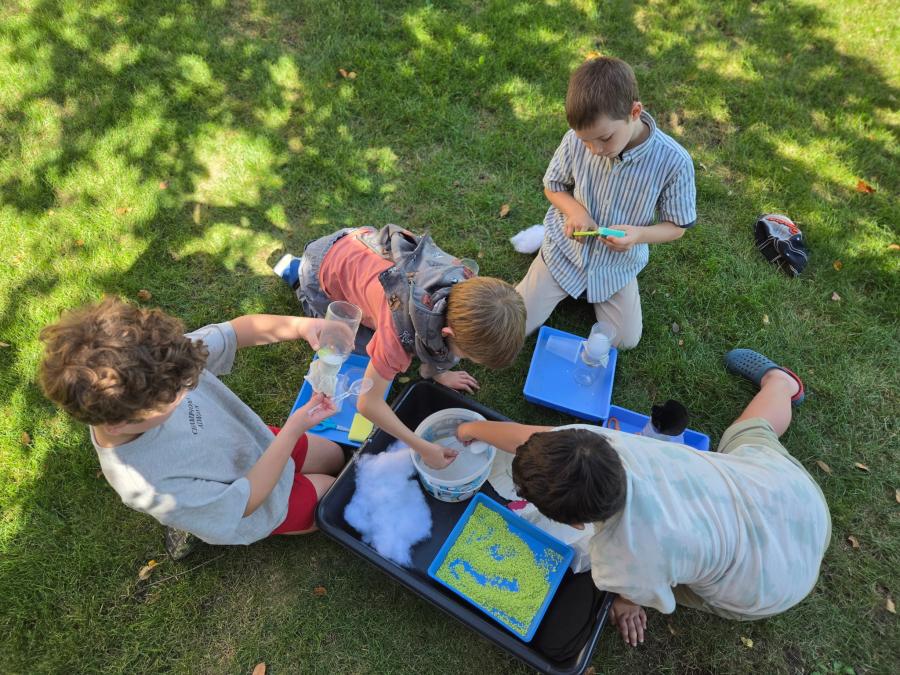
Reading, Writing, and Math in the Outdoor Classroom
Outdoor time does not replace the language block. It supplies material for it. Children who keep a field journal are writing daily, and the journal becomes a record of handwriting, sentence structure, and spelling progress a teacher can review.
Mathematics follows the same logic. Counting seedlings, measuring bed dimensions, tracking rainfall, and charting germination all require real computation. What most guides miss is that this only counts as academics when the teacher names the skill, connects it to grade-level standards, and revisits it indoors. Otherwise it is a nice afternoon.
How Academic Standards in Outdoor Education Get Met
Academic standards in outdoor education are met when a school maps every outdoor activity to a written standard and can show you that map. Ask for the document. A program that cannot produce one is improvising.
At Headwaters, our teachers are experienced educators who hold master's degrees. Frequent outdoor exploration sits alongside structured academics rather than replacing them.
The mechanism is less mysterious than it sounds. A rigorous nature-based school keeps a standards map, sometimes called a curriculum crosswalk, that lists each grade-level standard in reading, writing, mathematics, and science in one column and the specific instructional experiences that teach it in another. A second-grade measurement standard might be taught through garden bed planning and then reinforced with a ruler-and-graph unit indoors.
Parents can test this on a visit without any expertise in curriculum design. First: "Show me the standard for one skill my child will learn this year, and show me where it is taught outside and where it is retaught inside." Second: "What happens if my child does not meet that standard by the end of the unit?" A strong school describes a reteach plan, a small-group pull, or a conversation with the family. Third: "How do you know the outdoor lesson actually taught the standard and did not just occupy the afternoon?" The answer should involve some form of evidence, a work sample, a running record, an observation note tied to the standard, or a quick skills check.
Watch out: a school that shows you a beautiful outdoor campus but cannot produce a single written standard-to-activity map is selling atmosphere, not academics, and the gap will not show up until a child transitions to a conventional classroom.
The evidence base here is real but frequently overstated online. Rather than lean on a single headline number, we point families toward the research summaries published by the American Educational Research Association and toward our own explanation of how outdoor learning supports test scores.
How to Assess Nature-Based Learning Without a Standard Test
Nature-based schools commonly assess learning in several ways, and parents can ask which methods a given school uses.
The test to apply as a parent is simple: can the school show you a child's progress over time in a form you can read? You should see work samples from the fall and the winter, not just a narrative report full of adjectives.
What to Ask for During a School Visit
Bring this checklist. The answers tell you more than any brochure:
- The written scope-and-sequence for the grade your child would enter
- Two anonymized work samples showing growth across a term
- How reading progress is measured, and how often
- What happens when a student is behind grade level
- How much of the day is teacher-led instruction versus free exploration
- Whether outdoor time is scheduled or optional
- How the school handles a child who is struggling socially, not just academically
- What the school does after a conflict between students
That last pair matters more than most parents expect. A small school's culture is either built deliberately or left to chance. We would rather you ask.
Here is the visit checklist we hand parents, in the order we would ask it.
| What to ask for | Why it matters |
|---|---|
| Written scope-and-sequence for the grade | Shows what is taught by year end |
| Two anonymized work samples across a term | Shows growth you can read |
| How reading progress is measured, and how often | Confirms progress is tracked |
| What happens when a student is behind grade level | Reveals the reteach plan |
| Teacher-led instruction versus free exploration | Shows how the day is structured |
| Whether outdoor time is scheduled or optional | Tests whether outdoors is instruction |
| How a struggling child is supported socially | Shows culture is built deliberately |
| What the school does after a student conflict | Shows harm repair is planned |
The Disadvantages of Forest Schools Parents Should Weigh
The disadvantages of forest schools are real and worth naming plainly. Weather disrupts the schedule. Some children need more transition support than a fully outdoor day allows. And a program without a written curriculum can drift toward play, however good the intentions.
The weather point is not trivial in northern Illinois. January is cold, and a school that treats outdoor time as mandatory in all conditions needs a genuine plan for gear, warming breaks, and indoor space. Ask what the indoor learning spaces look like, because a strong program has them and uses them daily.
There is a second cost that gets less attention: parent logistics. A farm campus usually sits outside the urban core, and families drive. If you are weighing a commute from the Fox Valley, ask how many families are local and how the school builds connection across distance. Belonging is not automatic, and a school that pretends otherwise is not being honest with you.
How Nature Schools Prepare Students for High School and Beyond
Students from well-run nature schools can move into conventional high schools when their reading, writing, and math skills match grade-level expectations.
Families planning further ahead can review our developing high school program for the longer view. We are building it deliberately rather than quickly, and we would rather say so than promise a date we cannot hold.
Choosing a Nature School in Aurora, IL: What to Look For
Choosing a nature school comes down to checking a few things: a written curriculum, teachers with real training, assessment records, and a school culture you can observe on a visit.
Start with the curriculum verification. Before you visit, ask the school to send the scope-and-sequence for the grade your child would enter, plus one sample unit plan.
Then verify the teaching. Ask how many lead teachers hold master's degrees and how long they have taught. Ask, too, who supervises outdoor time and whether that person is a teacher or an aide.
Assessment is the third check. Ask to see sample work from the same child across a term, and ask how reading progress is measured and how often.
Culture is the fourth check, and it is the one you verify in person. Ask what a school does after a conflict between students and how it handles a child who is struggling socially rather than academically.
Local logistics deserve their own pass. Drive the route at the actual drop-off hour before you commit. Ask how many families live within a short drive and how the school builds connection across distance.
Finally, ask the school what it does not do well. A young school should be candid about what it is still building. We are new at running a school, and we say so.
Visit Headwaters and See the Academics for Yourself
The fastest way to judge rigor is to watch a lesson. Headwaters is a Montessori-inspired K-12 academy on a nonprofit community farm in Kane County, Illinois.
Families who want to see the full model can read how Headwaters structures its school days, and those ready to move can begin the K-12 admissions conversation with our team. Homeschooling families can also explore our home learning resources for curriculum support at a distance.
The real test of any nature school is whether it can show you, on paper and in person, that your child is learning to read, write, and reason at grade level while also learning to notice the world. Ask for the documents. Watch a lesson. Then decide.
Frequently Asked Questions
Can students get a rigorous academic education at a nature-based school?
Yes, when the school treats outdoor time as a setting rather than a substitute for instruction. Look for a written scope and sequence for each grade and teachers who hold real credentials. At Headwaters, our teachers hold master's degrees, and rigorous academics sit alongside land-based projects rather than competing with them. Ask any school to show you its curriculum documents before you decide.
How do nature schools teach reading, writing, and math?
The same skills, taught in more places. Phonics, comprehension, grammar, and number sense follow a sequence just as they do in a traditional classroom, but a nature-based education curriculum ties practice to real material: measuring garden beds, recording weather data, writing up observations, reading field guides. The work is hands-on, but the underlying skills are the standard ones. Ask how much time each day is protected for direct instruction in these subjects.
What are the disadvantages of forest schools I should weigh?
Common concerns with nature-based programs include weather, gear, and whether direct instruction is thin. Visit in bad weather, ask how much teacher-led instruction happens weekly, and ask what the school does when a child is behind in reading or math.
How do nature-based schools assess student progress?
Good schools use more than one measure of progress. Ask which assessments a school uses, how often, and how it shares results with families. Ask how to assess nature-based learning at the school you are considering: which assessments they use, how often, and how they share results with families. A school that cannot describe its assessment process in specific terms is worth a second look.